
Regular Abstract Submission
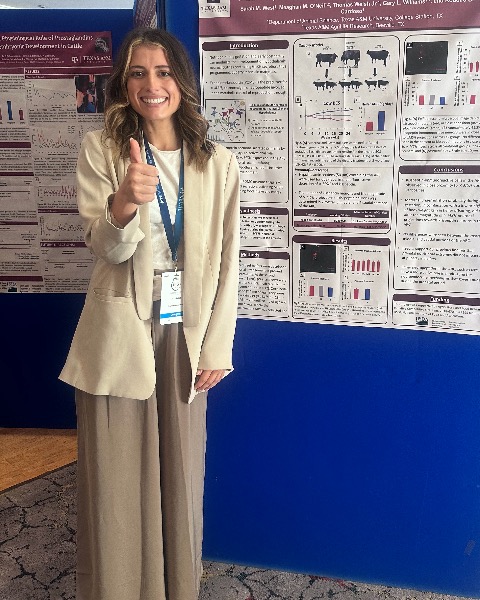
Sarah West, MS
Graduate Student
Texas A&M University
Bryan, Texas, United States
Sarah West1; Lucas O. e Silva1,3; Viviana Garza1; Jessica Sustaita-Monroe1; Leslie King1; Sarah Bynum1; Morgan Weynand1; George Perry2; Roberto Sartori3; Rodolfo C. Cardoso1.
1. Department of Animal Science, Texas A&M University, College Station, TX, 77843, USA.
2. Texas A&M AgriLife Research and Extension Center, Overton, TX, 75684, USA.
3. Department of Animal Science, Luiz de Queiroz College of Agriculture, University of São Paulo (ESALQ/USP), Piracicaba, SP, 13418-900, Brazil.
Abstract Text:
An increase in production of animal protein will be required to meet global food demands. Most of this increase must come from subtropical and tropical regions, where more than 70% of the world’s cattle are located and consist predominantly of Bos indicus and Bos indicus-influenced breeds. In the U.S., Bos indicus-influenced females represent ~30% of the cow herd. Nonetheless, these females have phenotypic characteristics that impair reproductive efficiency compared to Bos taurus females, including delayed puberty and inefficiencies related to the pharmacological control of ovulatory cycles. Indirect scientific evidence suggests that the latter is associated with a greater sensitivity of Bos indicus females to progesterone (P4) negative feedback, however, well-controlled experiments are lacking. Our hypothesis was that Bos indicus and Bos indicus-influenced heifers have a greater sensitivity to P4 negative feedback on LH secretion compared to Bos taurus heifers. Post-pubertal heifers (Hereford HF [Bos taurus]; n=6; Brahman BR [Bos indicus]; n=8; and Brahman x Hereford F1 [Bos indicus-influenced]; n=7) were ovariectomized and received two estradiol-17β (E2) implants to create basal E2 concentrations (3.1±0.6 pg/mL). Each heifer was submitted to two distinct P4 conditions: High P4 (HP4), heifers received two intravaginal P4 devices each on d-5, kept throughout the experiment; or absence of P4 (NoP4), heifers did not receive P4. On d-1, jugular catheters were placed and blood samples collected every 15min for 8h. LH concentrations were determined by RIA and data were analyzed as one-way ANOVA with Tukey’s HSD. At start of sampling, P4 circulating concentrations were greater HP4 (3.4±0.2 ng/mL) than the NoP4 period (0.07±0.02 ng/mL) but did not differ among breeds. During the HP4 period (2.3±0.4 pulses), LH pulse frequency was decreased compared to NoP4 (4.5±0.6 pulses). Similarly, mean LH concentrations were decreased in HP4 (0.4±0.05 ng/mL) compared to NoP4 (1.1±0.2 ng/mL). Nonetheless, no differences were found in LH pulse frequency among breeds, regardless of P4 treatment (BR=3.8±0.6; F1=4.7±0.6; HF=4.3±0.6 pulses). Under NoP4 conditions, BR heifers (0.7±0.1 ng/mL) had decreased mean LH concentrations compared to F1 (1.4±0.2 ng/mL). However, during the HP4 treatment, no differences were observed. Additionally, regardless of the P4 treatment, no differences in LH baseline concentrations were observed among breeds. Under NoP4 conditions, BR (1.3±0.1 ng/mL) had a decreased LH pulse peak compared to F1 (1.9±0.2 ng/mL) and HF (2.0±0.2 ng/mL), whereas no differences were observed under HP4 conditions. Under NoP4 conditions, LH pulse amplitude was decreased in BR (0.6±0.05 ng/mL) compared to HF (0.9±0.1ng/mL), while F1 (0.6±0.1 ng/mL) did not differ from either. No differences were observed in LH pulse amplitude during the HP4 period. In conclusion, elevated P4 concentrations suppressed LH pulse frequency in ovariectomized Bos taurus, Bos indicus, and Bos indicus-influenced beef heifers in a similar manner. Although pulse frequency was similar among groups, under NoP4 conditions BR had a decreased LH pulse peak compared to F1 and HF, suggesting that BR heifers may have an increased inhibitory tone on GnRH/LH secretion independent of P4. These results go against the previous dogma that Bos indicus females are more sensitive to the P4 negative feedback than Bos taurus heifers. Future studies comparing the sensitivity of the neuroendocrine axis to the P4 negative feedback in ovary-intact heifers as well as adult Bos taurus vs. Bos indicusfemales are warranted.